
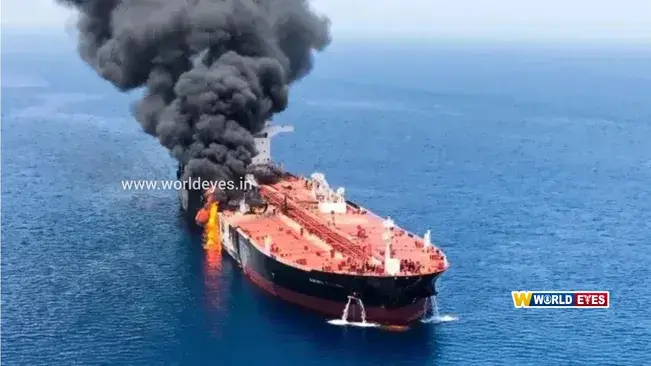
Fresh maritime tensions have emerged in the strategically important Strait of Hormuz after at least four oil tankers were reportedly damaged within 24 hours. According to Iran's navy, the fourth tanker caught fire after striking a sea mine in the eastern part of the waterway. Meanwhile, the United Kingdom Maritime Trade Operations (UKMTO) reported an attack on another tanker off the coast of Oman.
In a statement broadcast by Iranian state media IRIB, the Iranian Navy's public relations department said the tanker involved in the latest incident was passing through a restricted area in the eastern Strait of Hormuz with its navigation systems switched off. The navy claimed that the vessel sustained significant damage.
Iranian naval authorities also issued a warning to ship operators, advising them not to enter restricted maritime zones without prior coordination with the country's armed forces.
According to a report by Al Jazeera, the statement warned that unauthorised movement through restricted waters could result in vessels encountering sea mines and fire. The Iranian Navy stressed that compliance with maritime regulations and coordination with its armed forces were essential for safe passage through the area.
Three Tankers Reportedly Hit Earlier
The latest incident follows reports from Saturday, when Iranian naval forces said three oil tankers had struck sea mines in and around the Strait of Hormuz, resulting in explosions and fires.
With the latest reported incident, the number of tankers said to have been damaged has risen to at least four.
UKMTO Reports Attack Near Oman's Coast
Separately, the UK Maritime Trade Operations (UKMTO) issued an advisory regarding an attack on a tanker approximately seven nautical miles off the coast of Khasab, Oman.
According to the agency, the incident was reported by a third party. All crew members aboard the vessel were reported safe. However, the extent of the damage to the ship remains unclear.
Why the Strait of Hormuz Matters
The Strait of Hormuz connects the Persian Gulf with the Gulf of Oman and the Arabian Sea. It is one of the world's most important maritime routes for transporting crude oil and petroleum products.
Any disruption to shipping through this narrow waterway could have significant consequences for international energy markets, oil prices, shipping insurance costs and global supply chains.
India, one of the world's major crude oil importers, is particularly sensitive to developments in the region, as a substantial volume of its energy imports passes through this strategic route.
With multiple incidents involving oil tankers being reported, maritime security in and around the Strait of Hormuz has become a growing concern for global shipping and energy markets.
Reader Discussion (0)
Leave a Reply
Your email address will not be published. Required fields are marked *