
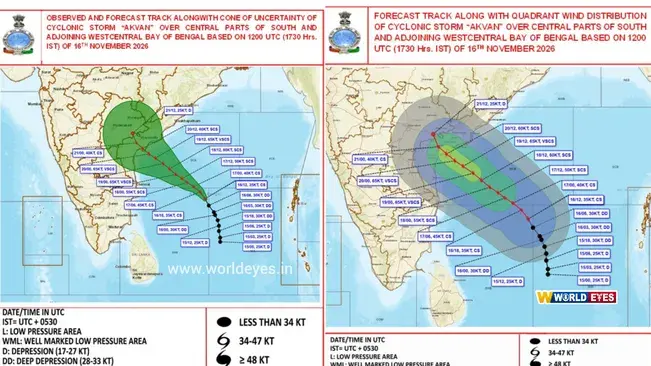
New Delhi: The deep depression over the Southeast and adjoining Southwest Bay of Bengal has intensified into cyclonic storm “Akvan,” the India Meteorological Department (IMD) announced on Monday. The storm is moving north-northwestwards and is expected to strengthen further over the coming days.
According to the IMD, Cyclone Akvan moved north-northwestwards at a speed of 10 kmph during the past six hours before intensifying into a cyclonic storm.
Cyclone Akvan: Current Location and Distance from Coast
At 5:30 PM IST, the cyclonic storm was centred over the central parts of the South and adjoining West-Central Bay of Bengal, near latitude 12.2°N and longitude 85.7°E.
The storm was located approximately:
- 610 km east of Chennai, Tamil Nadu
- 630 km northeast of Trincomalee, Sri Lanka
- 660 km southeast of Machilipatnam, Andhra Pradesh
- 670 km south-southeast of Visakhapatnam, Andhra Pradesh
- 790 km south of Gopalpur, Odisha
Cyclone Akvan Likely to Become Very Severe
The weather department has forecast that Cyclone Akvan will continue moving north-northwestwards and intensify into a severe cyclonic storm over the West-Central Bay of Bengal by Tuesday evening.
Thereafter, the system is expected to move northwestwards and strengthen further into a very severe cyclonic storm by the morning of November 19.
Andhra Pradesh Coast Faces Potential Cyclone Landfall
According to the IMD forecast, Cyclone Akvan is likely to cross the Andhra Pradesh and Yanam coasts between Nellore and Tuni around noon on November 20.
The storm is expected to make landfall as a very severe cyclonic storm, with maximum sustained wind speeds of 120–130 kmph and gusts reaching up to 145 kmph.
The forecast indicates the possibility of a significant weather impact along the Andhra Pradesh coastline, with further updates and advisories expected from the meteorological department as the cyclone approaches.
IMD Monitoring Cyclone Akvan's Movement
The IMD is closely monitoring the movement, intensification and projected landfall of Cyclone Akvan over the Bay of Bengal.
Residents in coastal areas are advised to follow official weather bulletins and safety advisories issued by the authorities.
Reader Discussion (0)
Leave a Reply
Your email address will not be published. Required fields are marked *