
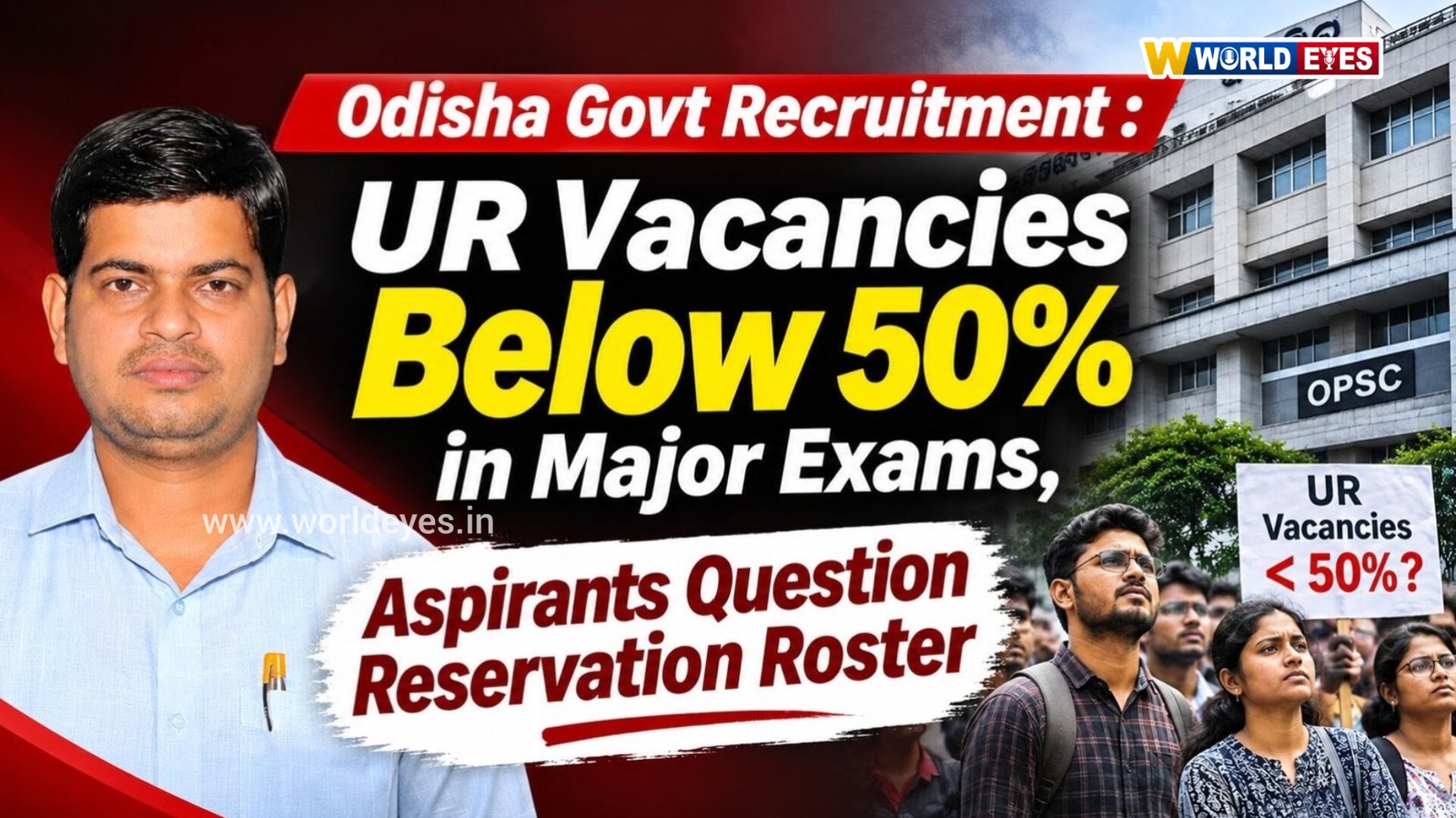
Bhubaneswar, Odisha: The category-wise distribution of vacancies in Odisha government recruitment examinations has triggered fresh concerns among job aspirants, with questions being raised over the share of Unreserved (UR) posts in several major recruitment drives.
Aspirants have pointed out that UR vacancies have remained below 50 per cent in multiple recruitment examinations conducted by the Odisha Public Service Commission (OPSC) and the Odisha Staff Selection Commission (OSSC). The issue has gained particular attention following the announcement of 340 Assistant Section Officer (ASO) vacancies in the Odisha Secretariat.
According to the vacancy figures cited by aspirants, only 144 posts have been allocated to the UR category in the OPSC ASO recruitment, accounting for approximately 42.35 per cent of the total vacancies.
The figures have prompted demands for a review of the category-wise vacancy distribution and greater transparency regarding reservation rosters and backlog vacancies.
OPSC ASO Recruitment: Only 144 UR Posts Out of 340
The OPSC Assistant Section Officer recruitment for 340 Secretariat posts has emerged as a major point of discussion among job aspirants.
According to the reported category-wise distribution, the vacancies are as follows:
- Unreserved (UR): 144
- Socially and Educationally Backward Classes (SEBC): 38
- Scheduled Castes (SC): 81
- Scheduled Tribes (ST): 77
The UR category accounts for 42.35 per cent of the total vacancies, while the remaining posts have been distributed among the reserved categories.
Aspirants have questioned why the UR vacancy share is below 50 per cent and have demanded an increase in the number of posts allocated to the category.
UR Vacancy Share Below 50% in Other Major Recruitment Exams
The issue is not confined to the OPSC ASO recruitment. Aspirants have also highlighted category-wise vacancy figures from several other major recruitment examinations conducted in Odisha.
OSSC CGL 2025
The Odisha Staff Selection Commission Combined Graduate Level Recruitment Examination 2025 reportedly includes 1,578 vacancies.
The category-wise distribution is:
- UR: 681
- SEBC: 207
- SC: 274
- ST: 416
The UR category accounts for approximately 43.16 per cent of the total vacancies.
OPSC OCS 2025
The Odisha Civil Services examination 2025 reportedly has 465 vacancies.
The distribution is:
- UR: 193
- SEBC: 51
- SC: 82
- ST: 139
The UR share stands at approximately 41.51 per cent.
OPSC OCS 2024
The OPSC Odisha Civil Services recruitment for 2024 reportedly includes 200 vacancies.
The category-wise distribution is:
- UR: 70
- SEBC: 35
- SC: 45
- ST: 50
The UR category accounts for 35 per cent of the total vacancies.
These figures have been cited by aspirants to highlight what they describe as a recurring pattern of UR vacancies remaining below 50 per cent across different recruitment examinations.
Why Are Aspirants Demanding 50% UR Vacancies?
Job aspirants have argued that the Unreserved category should receive at least 50 per cent of the total vacancies in state government recruitment examinations.
In the case of the OPSC ASO recruitment, candidates are demanding an increase in UR vacancies from the existing 144 to 170 posts.
According to their demand, allocating 170 posts to the UR category would represent 50 per cent of the total 340 vacancies.
They have urged the Odisha government and the recruitment commissions to review the existing vacancy distribution and take necessary steps to address their concerns.
Demand for Transparency in Reservation Roster
Apart from the demand for an increase in UR vacancies, aspirants have also called for greater transparency in the recruitment process.
They want the government and recruitment commissions to disclose complete details of:
- Category-wise vacancy allocation
- Reservation roster points followed in the recruitment
- Backlog vacancies, if any
- The basis for determining the number of posts under each category
- Applicable reservation rules and their implementation
According to aspirants, making these details public would help candidates understand the vacancy distribution and strengthen confidence in the recruitment process.
Does UR Category Automatically Mean 50% of Vacancies?
The demand for 50 per cent UR vacancies has also brought the reservation system into focus.
It is important to note that Unreserved vacancies are generally open to candidates from all categories based on merit and are not necessarily exclusive to candidates who do not belong to reserved categories.
The percentage of UR vacancies in a particular recruitment may depend on the applicable reservation framework, roster system, recruitment rules, backlog vacancies and the nature of the posts.
Therefore, a UR vacancy share below 50 per cent does not, by itself, establish that the recruitment process is irregular or violates reservation rules.
The exact position can be determined only after examining the applicable rules and the recruitment-specific reservation roster.
Aspirants Appeal to Odisha Government
Job aspirants have appealed to the Odisha government, OPSC and OSSC to address their concerns and provide a clear explanation of the category-wise vacancy distribution.
In particular, they have demanded that the 144 UR vacancies in the OPSC ASO recruitment be reviewed and increased to 170 posts, subject to applicable recruitment and reservation rules.
They have also urged the authorities to publish the complete reservation roster and details of backlog vacancies to ensure transparency and clarity.
For thousands of candidates preparing for Odisha government jobs, the issue has become an important matter of recruitment policy, fairness and equal opportunity.
The demand for transparency is now expected to draw further attention as aspirants seek clarification from the government and recruitment commissions over the distribution of vacancies in major state recruitment examinations.
Transparency, fairness and equal opportunity remain central to maintaining public confidence in government recruitment.
Reader Discussion (0)
Leave a Reply
Your email address will not be published. Required fields are marked *