
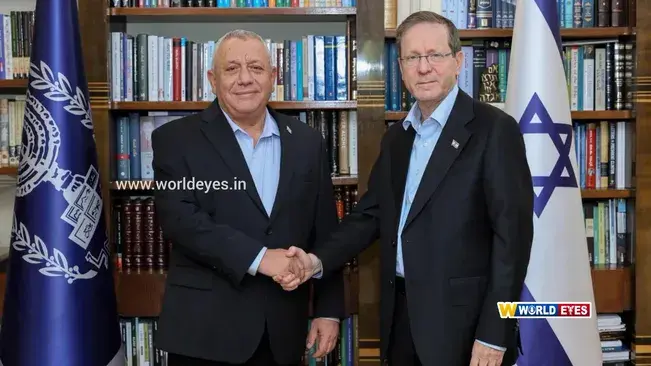
Jerusalem: Israel is witnessing a major political development as former army chief and Benjamin Netanyahu's prominent political rival, Gadi Eisenkot, has been formally tasked with forming the next government. Israeli President Isaac Herzog handed Eisenkot the mandate on November 8, following consultations with political parties after the October 27 election failed to produce a clear parliamentary majority.
Eisenkot, leader of the Yashar Party, now faces the challenging task of bringing together parties with sharply different political ideologies to secure the support of at least 61 lawmakers in Israel's 120-member parliament, the Knesset.
67 Lawmakers Recommend Eisenkot
During consultations with the president, 67 lawmakers reportedly recommended Eisenkot for the opportunity to form the government, while 46 supported Netanyahu.
However, these recommendations do not automatically guarantee a parliamentary majority. Eisenkot must negotiate political agreements and secure the support of additional parties to establish a stable government.
The president's decision marks a significant challenge to Netanyahu, whose Likud Party emerged as the largest single party in the October 27 election but failed to secure a majority with its existing coalition.
28 Days to Form Government, Extension Possible
Under Israeli rules, Eisenkot has 28 days to form a government. If he fails to reach an agreement within that period, the president may grant an additional 14 days.
This gives him a maximum of 42 days to secure the necessary parliamentary support.
Until a new government is sworn in, Benjamin Netanyahu will continue serving as caretaker prime minister.
Arab Parties Could Hold the Key
One of Eisenkot's potential routes to power is securing support from Arab-led parties, which collectively hold 19 seats.
Their backing could significantly strengthen his parliamentary position. However, incorporating these parties into a governing coalition remains politically sensitive, as Eisenkot and some of his allies have expressed reservations about including Arab parties in the government.
Despite these challenges, Arab parties reportedly recommended Eisenkot to the president as their preferred candidate to form the next government.
Netanyahu has criticised the possibility of a government relying on Arab-party support and previously accused Arab parties of stealing votes during the election. These allegations have not been substantiated.
Ultra-Orthodox Parties: Another Political Challenge
Eisenkot could also seek support from ultra-Orthodox parties, which together hold 13 seats.
Their backing could help him reach the parliamentary majority required to form a government. However, a major disagreement remains over military service exemptions for ultra-Orthodox religious students.
Eisenkot and his allies have advocated extending compulsory military or national service to members of the ultra-Orthodox community, while these parties strongly oppose ending existing exemptions.
This issue could complicate negotiations and make a political agreement difficult.
National Unity Government: Will Netanyahu Join?
Another possible scenario is the formation of a national unity government involving Eisenkot and Netanyahu's Likud Party.
Netanyahu has already called for a national unity arrangement. However, Eisenkot and his allies have consistently opposed forming a government under Netanyahu's leadership.
Eisenkot's party has indicated that Likud and its allies could potentially join a government led by him, but Netanyahu himself has not been included in that proposal.
Netanyahu Could Get Another Opportunity
If Eisenkot fails to form a government within the prescribed period, the president may give another candidate the opportunity.
Netanyahu could also emerge as a potential contender in the next stage of government formation. If subsequent attempts fail, the Knesset may nominate another leader to try to establish a government.
The entire process could extend to approximately 100 days. If no candidate succeeds in forming a government within the stipulated timeframe, Israel could be forced into another election.
The country experienced prolonged political instability between 2019 and 2022, when five elections were held amid repeated coalition deadlocks.
The coming weeks are therefore expected to be crucial for Israel's political future, with Eisenkot's negotiations potentially determining whether the country moves towards a new leadership or another electoral showdown.
Reader Discussion (0)
Leave a Reply
Your email address will not be published. Required fields are marked *