
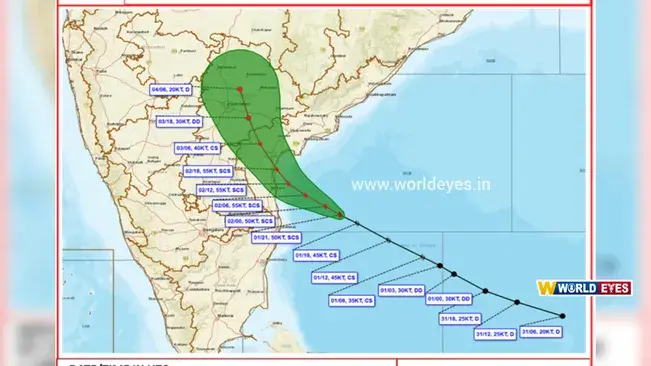
New Delhi: Cyclone Murasu has intensified into a severe cyclonic storm over the west-central and adjoining southwest Bay of Bengal and is moving rapidly towards the Andhra Pradesh coast.
According to the India Meteorological Department (IMD), the storm moved northwestwards at a speed of around 20 kilometres per hour during the past six hours. As of 2:30 AM IST on November 2, 2026, its centre was located over the west-central and adjoining southwest Bay of Bengal.
The system was positioned approximately 260 kilometres east-northeast of Chennai, 290 kilometres east-southeast of Nellore, 320 kilometres south-southeast of Machilipatnam and 330 kilometres southeast of Ongole.
The IMD has forecast that Cyclone Murasu will continue moving northwestwards and cross the South Andhra Pradesh coast as a severe cyclonic storm.
Landfall is expected between 11:30 PM on November 2 and 4:00 AM on November 3, between Nellore and Narsapur, near Ongole. At the time of landfall, wind speeds are likely to reach 100 to 110 kilometres per hour, with gusts up to 120 kilometres per hour.
The cyclone is expected to bring extremely heavy rainfall to several parts of coastal Andhra Pradesh and Yanam on November 2. Strong winds of 80 to 110 kilometres per hour are also likely in the affected areas.
The IMD has issued red and orange alerts for several parts of Andhra Pradesh and Rayalaseema, warning of very heavy to extremely heavy rainfall on November 2 and 3.
The impact of the storm is also expected to be felt in neighbouring Odisha, particularly in the southern districts, where heavy rainfall is forecast for November 3 and 4.
Authorities have warned that strong winds could damage kutcha houses, uproot trees and affect electricity poles and infrastructure in coastal areas.
Considering the dangerous sea conditions over the Bay of Bengal, the IMD has advised fishermen not to venture into the sea until at least Wednesday afternoon. Those already out in deep-sea areas have been advised to return to the coast immediately.
With Cyclone Murasu approaching, authorities are monitoring the situation and people in vulnerable coastal areas are being urged to follow official advisories and safety instructions.
Reader Discussion (0)
Leave a Reply
Your email address will not be published. Required fields are marked *